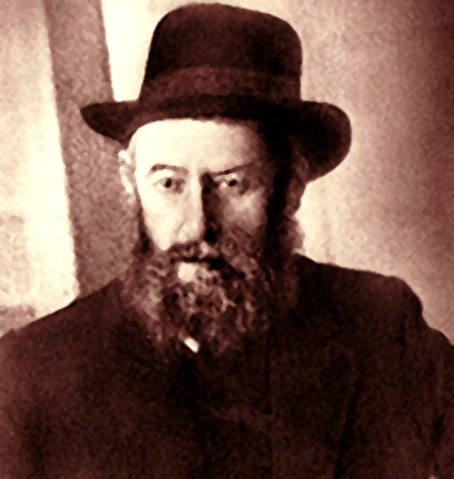
Biography
Rabbi Sholom Dovber Schneersohn, known as the Rebbe Rashab, was born in Lubavitch on 20 Cheshvan 5621 (November 5, 1860). He was the second son of Rabbi Shmuel, the fourth Lubavitcher Rebbe, and Rebbetzin Rivkah. His grandfather, the Tzemach Tzedek, chose his name himself. He was educated mainly by his father and later studied under Rabbi Shmuel Betzalel Sheftel. On 11 Elul 5635 (1875) he married his cousin Shterna Sarah, daughter of Rabbi Yosef Yitzchak of Ovruch.
His father passed away on 13 Tishrei 5643 (1882). Out of respect for his elder brother, Rabbi Zalman Aharon, he took on the leadership only gradually, fully accepting it, according to the Hebrew encyclopedia, on Rosh Hashanah 5654 (1893). For a long period he studied in seclusion, Gemara and halachic codes by day and Chassidus at night.
On 15 Elul 5657 (1897), at the Sheva Brachot of his son Yosef Yitzchak, he founded the Tomchei Temimim yeshiva in Lubavitch, where Chassidus was studied daily alongside Talmud and halachah; he set out its approach in Kuntres Etz HaChaim (1904). The yeshiva grew to some four hundred students, and he founded further yeshivot of the same name, as well as Toras Emes in Hebron in 5672 (1912).
He was deeply involved in the affairs of Russian Jewry: he fought the influence of the Haskalah and of Zionism, was among the leaders of the 1910 rabbinical assembly in St. Petersburg, and corresponded with the Torah leaders of his day, including Rabbi Chaim of Brisk and the Chofetz Chaim. His Chassidic discourses were collected in Sefer HaMaamarim, in twenty-nine volumes; among his best-known series are Yom Tov Shel Rosh Hashanah 5666 and Ayin Beis (5672). His other works include his letters (Igrot Kodesh), Toras Shalom, Kuntres HaTefillah and Kuntres HaAvodah.
In 5676 (1915), as the First World War approached, he left Lubavitch for Rostov-on-Don. He passed away there on Saturday night, the eve of 2 Nissan 5680 (March 21, 1920), appointing his only son, Rabbi Yosef Yitzchak, as his successor. First buried in the old Jewish cemetery of Rostov, he was later reinterred by chassidim in the city's new Jewish cemetery, where his grave is visited to this day.