
Biography
Rabbi Moshe ben Maimon, the Rambam or Maimonides, was born in Córdoba in 1138 (some say 1135), on the eve of Passover. He was educated by his father, Rabbi Maimon the Dayan, and through the writings of his father's teacher, Rabbi Yosef ibn Migash; he also regarded himself as a student of the Rif. He studied mathematics, medicine and philosophy as well.
In 1148 his family had to leave Córdoba in the face of the Almohad invasion. After some ten years of wandering, they settled in Fez, which they were forced to leave a few years later. In 1165 they sailed to Acre in the Land of Israel, from where the Rambam went up to pray in Jerusalem, and then moved on to Egypt: first Alexandria, then Fustat, near Cairo.
In Fustat he led the Jewish community, twice served as Ra'is al-Yahud, head of Egyptian Jewry, and presided over the rabbinical court. After the death of his brother David, who had supported the family and drowned in the Indian Ocean around 1177, he took up medicine; from 1185 he served as physician to the vizier al-Fadil and later to al-Afdal, son of Saladin. His son Avraham was born in 1186.
Works: the Commentary on the Mishnah, begun at the age of twenty-three, whose introduction to chapter Chelek (Sanhedrin 10) sets out the thirteen principles of faith; Sefer HaMitzvot; the Mishneh Torah, a code of all Jewish law in fourteen books, written between 1167 and 1177; the Moreh Nevukhim (Guide for the Perplexed); letters, responsa and medical treatises. Called "the Great Eagle", he is one of the foremost halakhic authorities, and it is said of him: "From Moshe to Moshe, there arose none like Moshe."
He passed away in Fustat on 20 Tevet 4965 (December 1204), at the age of sixty-six, and his son Avraham succeeded him. According to tradition, his body was brought to Tiberias at his request, and his tomb there is a place of pilgrimage.
Books & writings
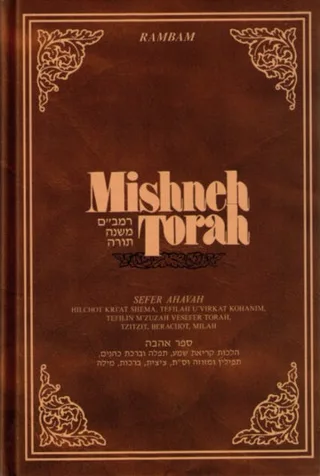
Mishneh Torah
משנה תורה
Comprehensive code of Jewish law.
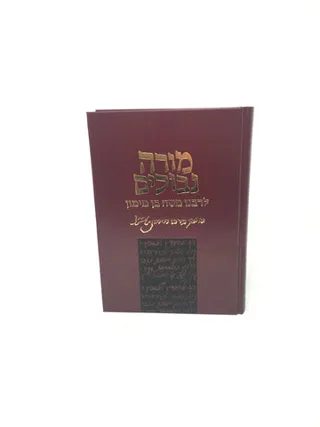
Guide for the Perplexed
מורה נבוכים
Major philosophical work.
Contacts & practical information
Municipalité de Tibériade
Open daily, free access. Many Tannaim and Amoraim are buried in the ancient Tiberias cemetery.