Biography
Rabbi Eliezer ben Yitzchak Papo, known as the Pele Yoetz after his most famous work, was born in 5545 (1785) in Sarajevo, then part of the Ottoman Empire, into one of the oldest Jewish families of Bosnia. His father was named Yitzchak and his mother Blanca. He studied in the city's yeshivot under Rabbi Eliyahu Chayun and Rabbi Moshe Danon, acquired broad learning, and wrote his first book in Sarajevo, Chodesh HaAviv, novellae on tractates Berachot, Shabbat and Eruvin.
After his marriage he settled in Silistra, Bulgaria, and became head of the local Sephardic community. In 1819 he went to Bucharest, where he reorganized the city's Sephardic community on the basis of its 1811 statutes and became its head, before returning to Silistra shortly afterwards.
His son, Rabbi Yehuda Papo, describes in his introduction to Chesed LaAlafim his father's asceticism: fasts, lashes on every night when supplications are recited, sackcloth and ashes, and immersions in snow. His student Rabbi Yehuda Alkalai related that a Jew of his community had been sentenced to death by the authorities and could be ransomed for a large sum; when the community leaders refused, Rabbi Papo ordered that all the Torah scrolls and ritual objects be sold to redeem him, reasoning that the Torah was given to Israel, and without Israel there is no Torah.
Works: Pele Yoetz, a work of musar arranged alphabetically, from which his name derives; Orot Eilim, customs and laws following the order of the Talmud, the Zohar and the books of the Chida; Responsa Pele Yoetz; Beit Tefillah, a collection of prayers and supplications; Elef HaMagen on the Bible; Chesed LaAlafim, an abridged Shulchan Aruch on Orach Chaim and Yoreh Deah interwoven with musar; Yaalzu Chasidim on Sefer Chasidim; and Dan Yadin, commentaries and homilies on the Torah.
He wished to go up to the Land of Israel but fell ill in 1826, when the name Yechezkel was added to his own. He died of plague during Chol HaMoed Sukkot, on 20 Tishrei 5588 (11 October 1827), at the age of 42, and was buried in Silistra; tradition links his death to the end of the epidemic in the city. Before his passing he declared that whoever prostrated himself on his grave after immersion, recitation of Psalms and heartfelt prayer would be answered. His grave remains a place of pilgrimage, and his son Rabbi Yehuda Papo went up with his family to Jerusalem.
Books & writings
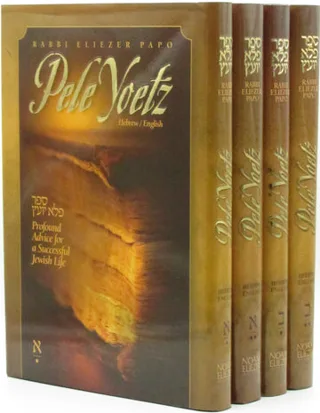
Pele Yoetz
פלא יועץ
Alphabetical guide to Jewish ethics.