
Biography
Rabbi Avraham ben Meir ibn Ezra, known by the acronym Raava (ראב"ע), was born in Tudela, Spain, in 4849 (1089), or according to another view in 1092. A poet, grammarian, Bible commentator and philosopher of the Golden Age of Spanish Jewry, he also worked in mathematics, astronomy and astrology, and wrote most of his books in Hebrew.
As a young man he left Tudela for Toledo, Lucena and Córdoba, then travelled in North Africa, where he befriended Rabbi Yosef ben Amram, judge of Sijilmasa, and Rabbi Shmuel ibn Jami' of Gabès. He was a friend of Rabbi Yehudah HaLevi. After the Almohad persecutions he composed the lament "Ahah yarad al Sefarad."
Around 1140–1145 he left Spain and led a wandering life: Rome, Salerno, Lucca, Mantua and Verona in Italy, then Béziers, Narbonne and Rouen in France, where he corresponded with Rabbeinu Tam, and finally London in 1158. Calling himself "Avraham the Sephardi," he spread in Hebrew the learning of Spanish Jewry, which until then had been written mostly in Judeo-Arabic; nearly all his books were written during these years of wandering.
In his Torah commentary, written in a concise and poetic style, he seeks the plain meaning (peshat) of each verse and separates it from derash, while accepting that practical halacha follows the Sages' interpretation. In London, on 15 Tevet 4919, he wrote Iggeret HaShabbat, recounting a dream in which an angel handed him a letter sent by the Shabbat, rebuking an explanation that made Shabbat run from Saturday morning to Sunday morning. Works: short and long commentaries on the Torah, commentaries on the Prophets and Writings, Moznayim, Safah Berurah, Sefat Yeter, Tzachot (grammar), Sefer HaIbbur, Sefer HaMispar, Sefer HaEchad, Yesod Mora, Iggeret HaShabbat and a diwan of poems.
He died on a Monday, 1 Adar I 4924 (27 January 1164), aged 75; another manuscript gives 4927 (1167). The place of his death is unknown. A tradition attested from the early 14th century places his grave in Kabul in the Galilee, and another, from the late 15th century, in Tiberias.
Books & writings
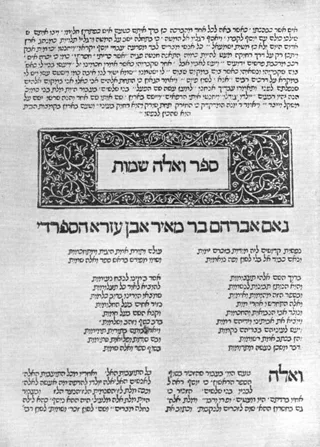
Ibn Ezra on the Torah
פירוש אבן עזרא
Grammatical and philosophical commentary.