Biography
Rabbeinu Yonah ben Avraham Gerondi, known as Rabbeinu Yonah HeChasid, was born around 4970 (1210) in Girona, Catalonia, to an illustrious family; other sources give 1180 or 1200. He was a cousin of the Ramban, whose mother was the sister of his father Rabbi Avraham, and he later married his daughter to Rabbi Shlomo, the Ramban's son.
In his youth he studied under Rabbi Shlomo ben Avraham of Montpellier (Min HaHar), of whom he was the most prominent pupil, and under the sages of Evreux, the brothers Rabbi Moshe and Rabbi Shmuel ben Shneur, whose yeshiva combined the method of the French Tosafists with the way of the Chasidei Ashkenaz; this combination deeply shaped his own path. He also studied with his cousin the Ramban.
Alongside his teacher he took part in the controversy against the Rambam's philosophical writings and in 1233 signed the ban against the Guide for the Perplexed and the Sefer HaMada. According to his pupil Rabbi Hillel of Verona, when the Talmud was burned in Paris in 1242, in the very place where the Rambam's writings had been destroyed, he saw in it a punishment from Heaven and publicly admitted in the synagogue of Montpellier that he had been wrong. He vowed to travel to Eretz Yisrael and prostrate himself on the Rambam's grave to implore his pardon before ten men for seven days, and according to this tradition composed Shaarei Teshuvah as part of his repentance. Some historians doubt the reliability of this account, which came from his opponents; Israel Ta-Shma defended it, noting that in his commentary on Berachot he cites the Rambam and often rules like him.
Having left France with that intention, he was detained in Barcelona and then in Toledo, where he was appointed rabbi in 1244 and became one of the great Talmudic teachers of his time; the Rashba was his student. He was renowned for the depth and sharpness of his Talmudic learning.
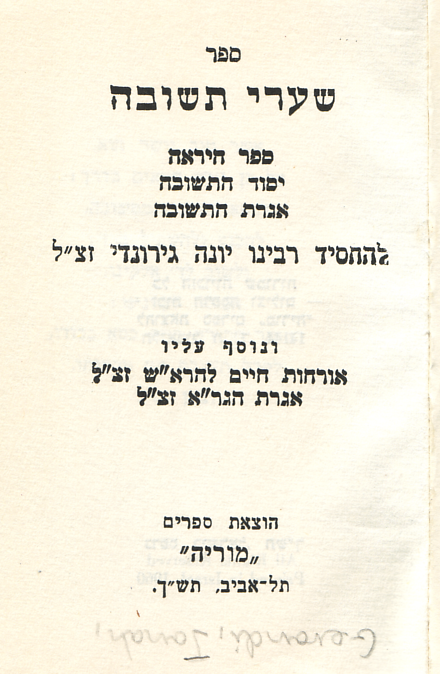
Works: Shaarei Teshuvah (The Gates of Repentance), the only surviving part of a larger ethical work entitled Shaarei Tzedek and one of the classics of musar literature, first printed in Fano in 1505; Sefer HaYirah; Iggeret HaTeshuvah; Aliyot deRabbeinu Yonah on Bava Batra; his students' commentary on the Rif to Berachot, written in his name; and commentaries on Pirkei Avot and on Proverbs.
He passed away in Toledo on 28 Cheshvan 5024 (November 1263), before fulfilling his vow. The text of his tombstone was later transcribed by Samuel David Luzzatto. According to Emek HaBacha by Rabbi Yosef HaKohen, his grave, like those of the Rosh and other sages of Toledo, was later plowed over to protect the bones, and its location is lost.
Books & writings
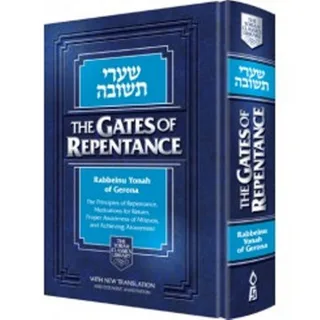
Sha'arei Teshuvah
שערי תשובה
The Gates of Repentance, a mussar classic.
Contacts & practical information
Office de Tourisme de Tolède
Toledo, the "Sephardic Jerusalem". The medieval Jewish cemetery has no officially identified location. The Sephardic Museum (El Tránsito Synagogue) can orient visitors.