
Biography
Rabbeinu Asher ben Yechiel, known as the Rosh, was born around 5010 (1250) in Ashkenaz, probably in Cologne. His father, Rabbi Yechiel, was a great Talmudic scholar who corresponded with the sages of his generation and was counted among the Chassidei Ashkenaz; among his ancestors was Rabbi Eliezer ben Nathan, the Raavan.
He first studied with his father and then in the yeshiva of the Maharam of Rothenburg, becoming his foremost disciple; teacher and student kept up an extensive halachic correspondence. When the Maharam was imprisoned in 5046 (1286), the Rosh stood surety for the ransom and collected the money. After his teacher died in captivity, he took his place at the head of the community of Worms and became the leading authority of German Jewry.
After the Rindfleisch massacres of 1298, fearing he would share his teacher's fate, he left Germany with his family in 5063 (1303) for Provence, and reached Spain in the autumn of 5065 (1305). The Rashba received him with great honor in Barcelona, and the community of Toledo invited him to settle there, appointing him head of its rabbinical court and Rosh Yeshiva, an exceptional appointment for a sage from Ashkenaz. He thus bridged the Ashkenazi tradition of learning and the reality of the Spanish communities.
His main work, Piskei HaRosh, is a halachic treatment of the tractates of the Babylonian Talmud, built on the Halachot of the Rif and enriched with the rulings of the Tosafists. He also wrote Tosafot HaRosh, commentaries on tractates Nedarim and Nazir and on the Mishnah, many responsa collected in Shut HaRosh, and Orchot Chaim. Rabbi Yosef Karo made him one of the three pillars of the Shulchan Aruch, alongside the Rif and the Rambam.
He had eight sons, among them Rabbi Yaakov, author of the Arba'ah Turim, and Rabbi Yehudah, who succeeded him in Toledo. He passed away in Toledo on 9 Cheshvan 5088 (1327) and was buried there; the location of his grave was later lost.
Books & writings
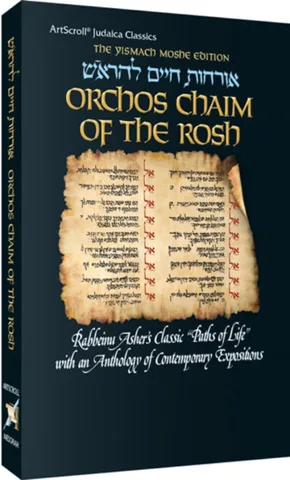
Orchot Chaim LeHaRosh
ארחות חיים להרא"ש
Ethical maxims of the Rosh.
Contacts & practical information
Office de Tourisme de Tolède
Toledo, the "Sephardic Jerusalem". The medieval Jewish cemetery has no officially identified location. The Sephardic Museum (El Tránsito Synagogue) can orient visitors.